Overview
The business at a glance
- Business
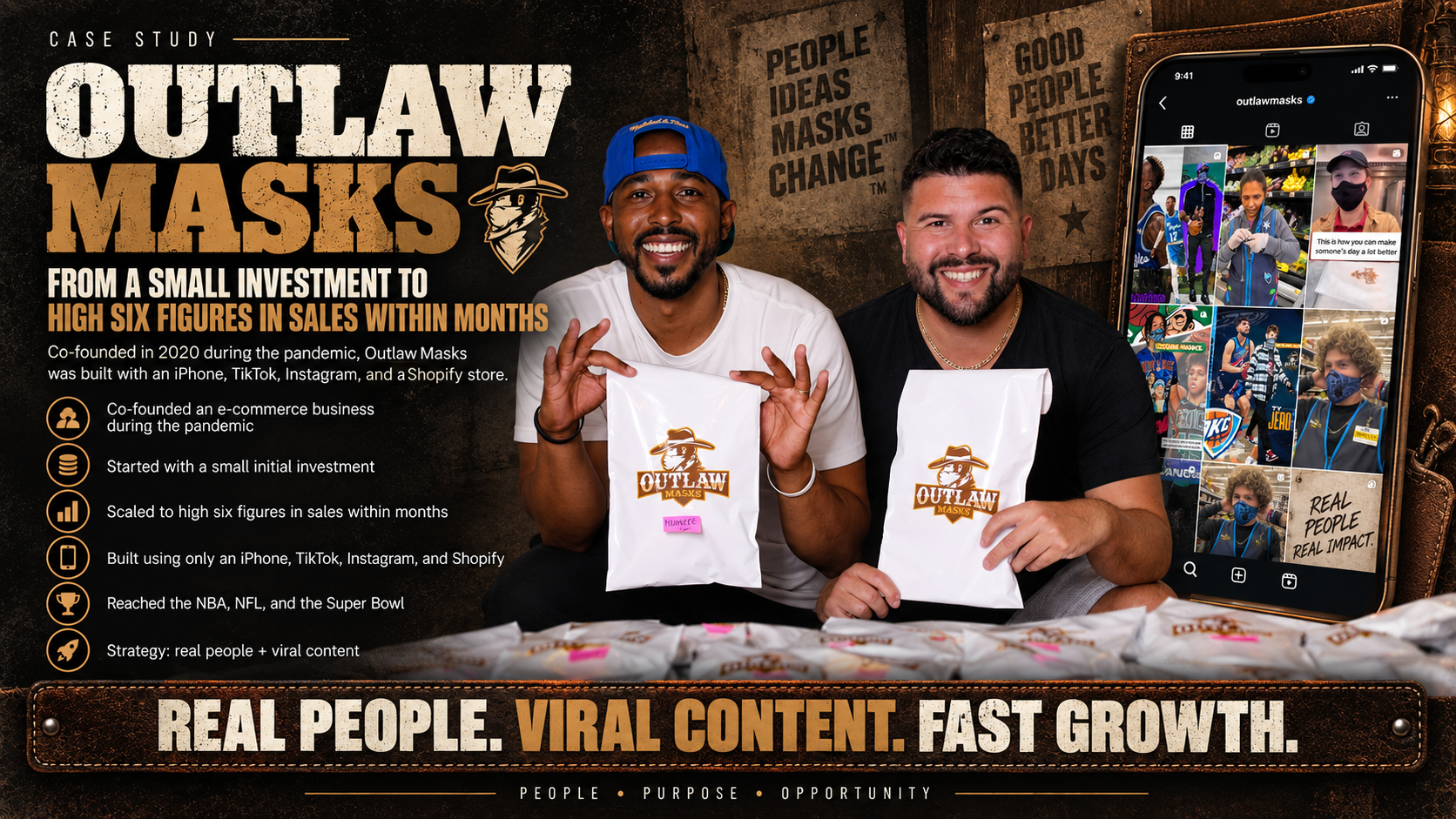
- Outlaw Masks, a direct-to-consumer mask brand.
- Founded
- 2020, during the pandemic.
- Starting point
- A small initial investment.
- Sales
- $500K+ within the first six months, as reported by the co-founder.
- Storefront
- Shopify.
- Content creation
- iPhone.
- Discovery
- People-led content on TikTok and Instagram.
- Follow-up advertising
- Facebook and Instagram retargeting and lookalike audiences.
The sales figure is founder-reported, not independently audited here. It describes sales, not profit. The tools listed are the core of this account, not an exhaustive inventory of every service the business used.
The product
We started with a product people needed
During the pandemic, we saw an opportunity to sell reusable, washable masks with more personality than a disposable face covering. But having a product people needed wasn't the same thing as giving them a reason to choose our brand.
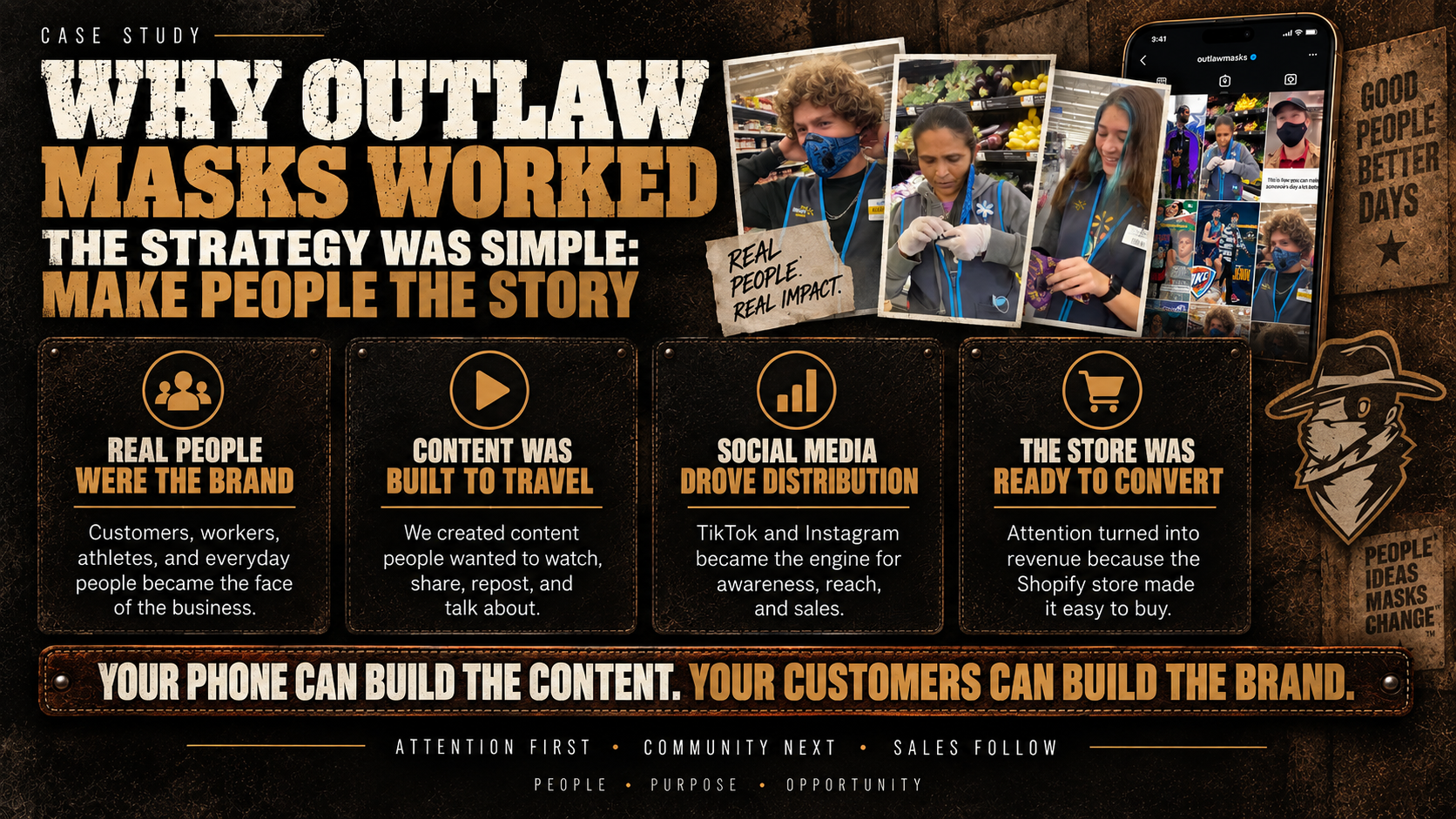
We had to earn that attention. Rather than make every post a product shot and a discount code, we made people the story. Customers, frontline workers and others wearing the masks became central to the content.
My background was in marketing, but running an ecommerce business brought a different kind of accountability. A post wasn't the finish line. Someone still had to visit the store, decide to buy and complete an order.
The content
The content worked because people were the story
We went into stores, including Walmart, gave masks to frontline workers and recorded their reactions. The phone was enough to capture the moment. The point wasn't to make a commercial look spontaneous. It was to put an actual person at the center of the story.
People had something to respond to beyond a product listing. They could recognize the work someone was doing, react to the interaction or share the video with someone else. That gave the content a reason to travel.
Some of those videos attracted millions of views. As I described in my account of the business, that attention brought visitors to the website and helped generate sales. We kept returning to the people-led approach rather than treating every post as a completely new campaign.
The lesson I took from it was not that production quality doesn't matter. It was that spending more on production wouldn't automatically make the story more interesting. We needed a moment worth watching before we needed better equipment.
The storefront
How attention reached the Shopify store
The path from our TikTok content to the business was straightforward: the profile linked to OutlawMasks.com, where customers could shop.
Shopify was the commerce layer. It gave that attention somewhere to go beyond another social post. When a viewer wanted the product, there was a storefront behind the brand.
That distinction matters. TikTok and Instagram helped people discover us. Shopify supported the purchase. Neither job replaced the other, and our result wasn't proof that a platform subscription could create demand on its own.
There was also a follow-up step. We used Facebook and Instagram retargeting to reconnect with people who visited the site without buying, alongside lookalike audiences. So this was not an organic-only or zero-ad-spend business. Organic content was important to discovery, and paid distribution was part of the wider approach.
This case study doesn't include a channel-by-channel attribution breakdown, so I won't assign a percentage of sales to any one channel. The historical approach is described here to explain what we did, not as a plug-and-play instruction for implementing tracking today.
Operating system
The stack behind the business
| Layer | Tool or approach | Its role |
|---|---|---|
| Content creation | iPhone | Record people and product moments without waiting on a production crew |
| Discovery | TikTok and Instagram | Give people a reason to notice and share the brand |
| Storefront | Shopify | Provide the place to browse and buy |
| Follow-up | Facebook and Instagram ads | Reconnect with visitors and reach lookalike audiences |
| Creative direction | Real people wearing and receiving the product | Make the content about more than a sales pitch |
This is why I push back on the idea that an impressive list of tools is a strategy. Our tools had distinct jobs. The important question was whether they helped the business move from a moment of attention to a customer relationship and a sale.
Evidence boundary
What worked, and what I wouldn't claim
The results gave us a story worth sharing, but they don't give me permission to turn every observation into a proven cause.
We built during an unusual period of demand. The product, timing, content, distribution and storefront all belonged to that context. Without a controlled comparison, I can't tell you how much revenue came from Shopify rather than another platform, or how much a particular video changed the business.
The presentation also describes exposure connected to the NBA, NFL and Super Bowl. Those references are part of the founder's account of the brand's reach, not a claim of an official league partnership, sponsorship or licensed relationship.
What I can explain is the operating lesson: attention was useful because there was a business ready to do something with it.
Lessons
What this taught me about choosing ecommerce tools
Start with the job, not the feature list
Before comparing platforms, write down what the business needs to do. For us, the connection between content, discovery and buying mattered. For another business, the difficult part may be inventory, wholesale orders or fulfillment. A tool deserves its place when it solves the problem in front of you.
Judge the journey, not just the homepage
A good-looking store is only part of the experience. As a buyer evaluating software now, I would walk through a product page, checkout, order handling and a refund before deciding how well a platform fits. That is a testing recommendation, not a claim that we documented all of those workflows in this historical case study.
Keep the stack understandable
Every additional app should have a purpose. My takeaway from Outlaw Masks is to build around the work the business actually needs done, then add complexity when there is a reason for it. Buying more software is not the same thing as building a stronger operation.
Treat sales and profit as different questions
The $500K+ figure is sales. It is not a margin claim, an advertising return or money taken home. Product costs, advertising, shipping, fees and other expenses belong in the economics of a business. A merchant comparing tools should model those costs rather than treat revenue as the whole scorecard.
Learn from the experience without pretending it is a current product test
Using Shopify in a business founded in 2020 gives me firsthand operating context. It does not replace testing Shopify's current plans, features or integrations. BestStorefront keeps those two kinds of evidence separate.
Why it matters
Why this story belongs on BestStorefront
I don't want BestStorefront to recommend software just because a vendor has a persuasive website or an attractive affiliate program. I want it to ask the questions that come up when somebody actually has to make the sale, handle the order and keep the business moving.
Outlaw Masks informs that perspective. It is one business, in one market moment, not a universal blueprint or a promise of what another founder will earn.
The lesson I keep coming back to is simple: the tools supported the business because we knew what we needed them to do.
Disclosure
Sources and scope
This is Carlos Gil's first-person account of a business he co-founded, supported by his presentation material and prior description of its growth strategy. The two graphics are original presentation artifacts, not independently verified analytics.
The $500K+ sales figure and six-month period are founder-reported. An audited financial statement, profit figure, advertising-spend total and channel attribution report are not supplied with this article. No current Shopify testing, conversion lift or guaranteed outcome is claimed.
BestStorefront's current Shopify page remains an independent editorial overview until the testing described in its methodology is completed. This case study does not award Shopify a score or determine a comparison result.
Research