Overview
The business at a glance
- Business
- The Hype Section
- Business type
- Sneaker and sports-card retail
- Location
- Jacksonville, Florida
- Founders
- Carlos Gil and Reggie Williams
- Year
- 2022
- Reported first-year revenue
- Approximately $1M (founder-reported)
- Locations
- One physical retail location
- Growth model
- Primarily organic, community-driven and built on owned customer data
- Commerce stack
- Shopify + Square
- Retention channels
- Email + SMS
- Research type
- Founder operator case study
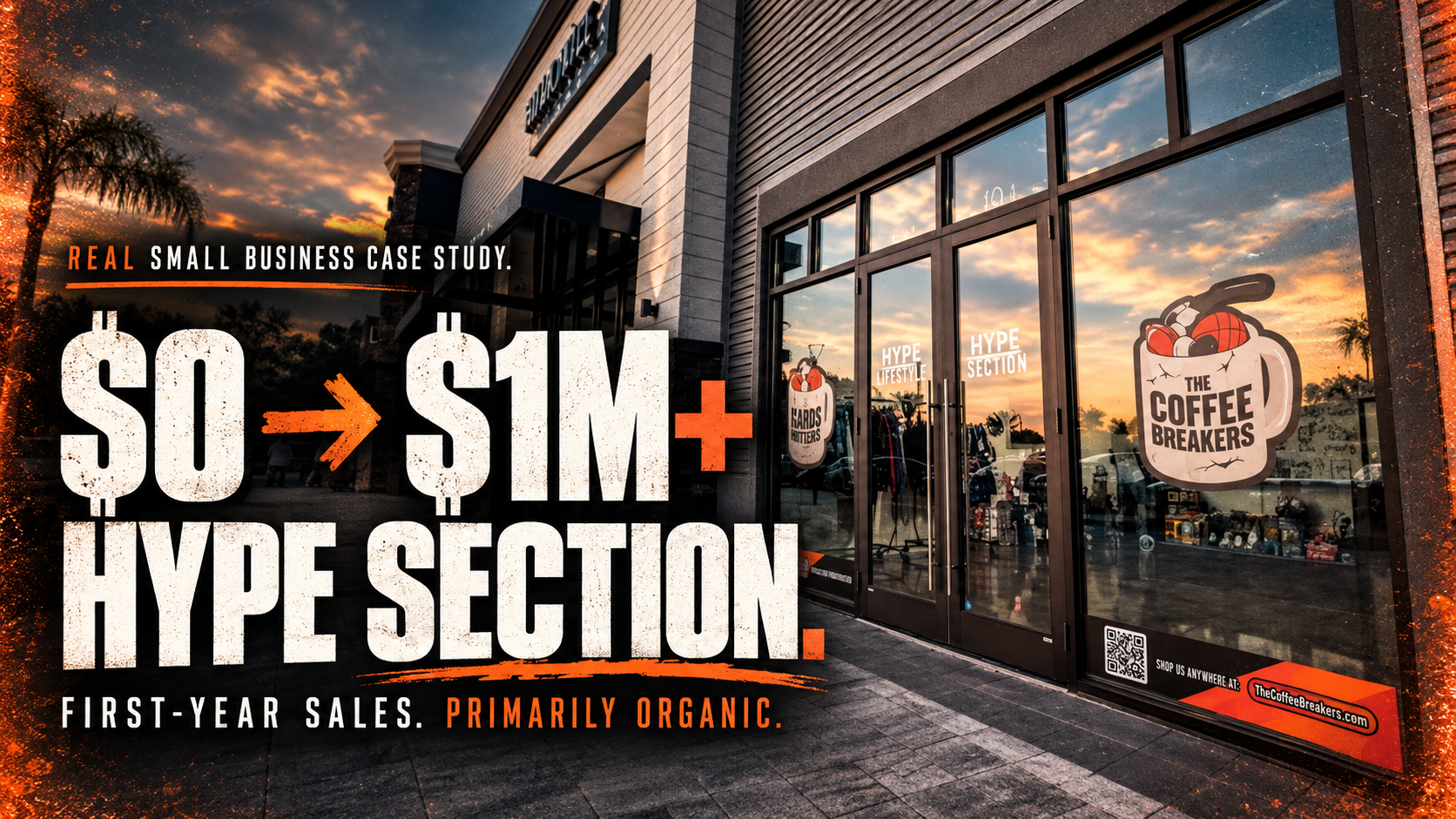
The revenue and operating metrics in this case study are founder-reported and have not been independently audited by BestStorefront. Revenue is not the same as profit.
The problem
Retail demand we couldn't afford to buy
After rent, buildout and inventory, there was very little left for marketing. The standard playbook of Facebook ads, Google Ads and an agency retainer wasn't financially realistic for us.
We also faced the usual brick-and-mortar problem: dependence on walk-in traffic. Waiting for people to find the store would not have been enough, especially when the same sneakers and cards were a few taps away on large online marketplaces.
So the operating question was not "which tool should we buy?" It was "how do we create recurring demand, and how do we make sure we can reach a customer again after the first sale?" That question shaped every system that followed.
Operating system
The stack behind the business
| Layer | Tool or approach | Role |
|---|---|---|
| Commerce / storefront | Shopify | Online commerce infrastructure and customer/order workflows |
| POS / transactions | Square | In-store transactions and customer capture |
| Customer data | Email + SMS capture (approach) | Turn transactions into an owned audience |
| Retention | Reactivation campaigns (approach) | Bring inactive and one-time buyers back |
| Loyalty | VIP / top-customer segmentation (approach) | Identify and reward high-value customers |
| Discovery | Instagram + customer content | Organic reach and social proof |
| Local acquisition | Google reviews / local SEO (approach) | Capture intent from local search |
| Community | Trade Nights + athlete events (approach) | Create repeat foot traffic and cultural relevance |
Rows marked "approach" describe a system or practice rather than a single software product. The table reflects the core of this account, not every service the store used, and it does not mean any one tool produced the revenue.
Discovery
The customer-as-content engine
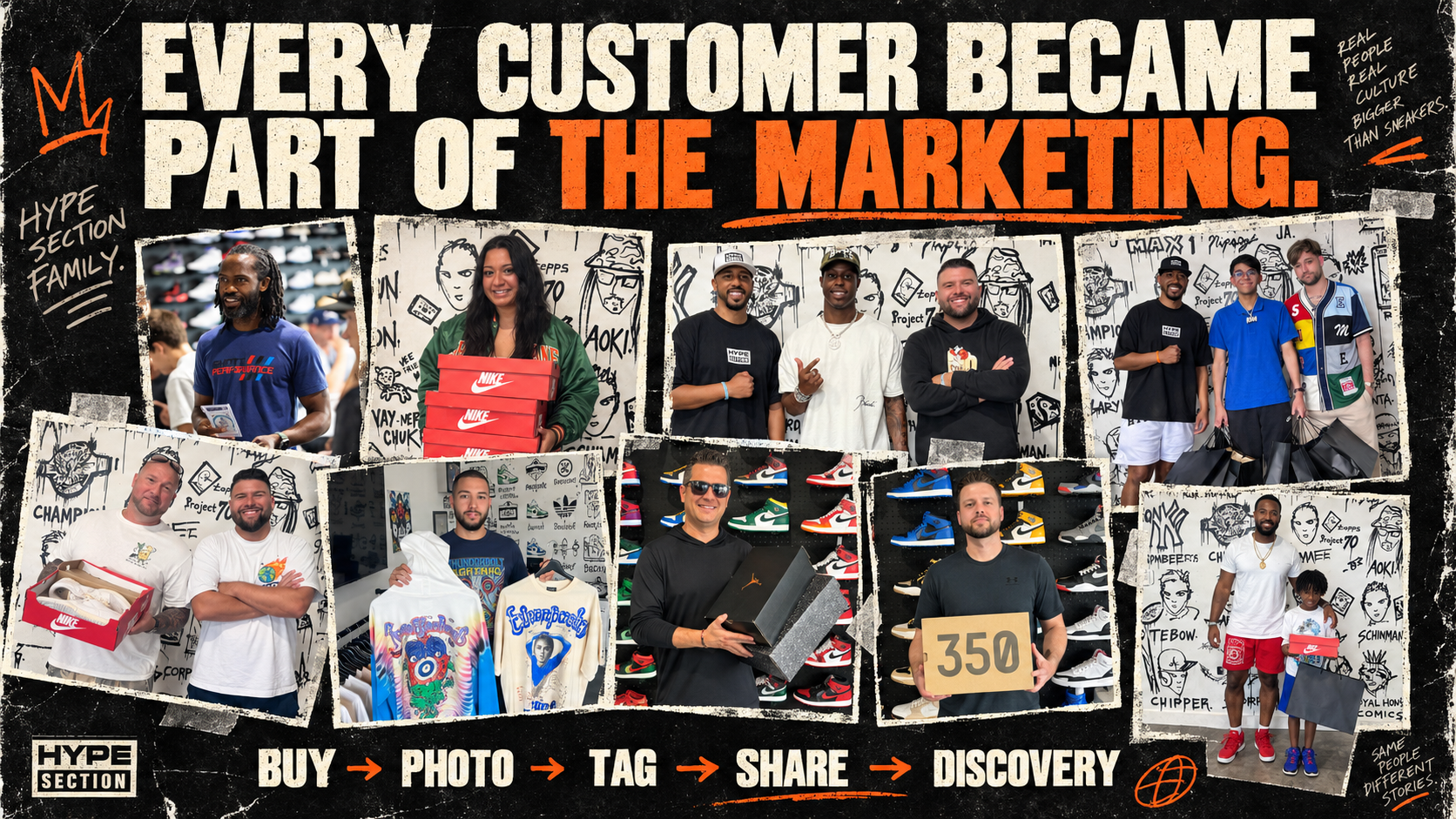
We treated each purchase as a piece of content. Customers took a photo at the sneaker wall mural, we posted it to Instagram, usually within a day, and tagged them. Many customers reposted it to their own followers.
That turned ordinary sales into organic distribution. Each happy customer showed the store to people we could not have reached on our budget. We did not track a conversion rate for those posts, so I won't attach a number to them.
Alongside Instagram, we posted regularly in local Facebook groups, Nextdoor areas and community groups within our trade area.
The transaction was not the end of the marketing journey. It became the beginning of another distribution loop.
Owned audience
Customer data as an asset
The most important commerce decision we made was to treat the checkout as a data-capture point. Square and Shopify checkout were set up to collect a customer's name, email, phone number and birthday at the sale.
A loyalty program gave customers a reason to share those details. By our own account, that drove capture to nearly 100% of transactions. That is a founder-reported figure, not an audited one.
The result was a customer file we owned. We could segment it by spend and recency, recognise our best customers, and reach one-time and inactive buyers directly instead of hoping an algorithm would show them our next post.
Social media created attention. The customer file created retention.
Any business collecting contact details for email and SMS should follow the consent and messaging rules that apply where it operates. This case study does not describe our compliance process in detail, so it should not be read as a compliance template.
Retention
The reactivation system
Each month, we used Square and Shopify reports to rank customers by spend. That simple report drove a set of repeatable actions:
- Our top 10% of customers were invited to VIP appreciation events.
- Customers inactive for 60+ days received a "we miss you" SMS with an offer.
- One-time buyers received structured follow-up sequences.
- Email and SMS broadcasts promoted events and new inventory to the full list.
Our account is that these broadcasts made demand more predictable and helped rescue slower weeks. We do not have campaign-level revenue figures to share, so this article doesn't claim any.
Community
Community as a growth channel
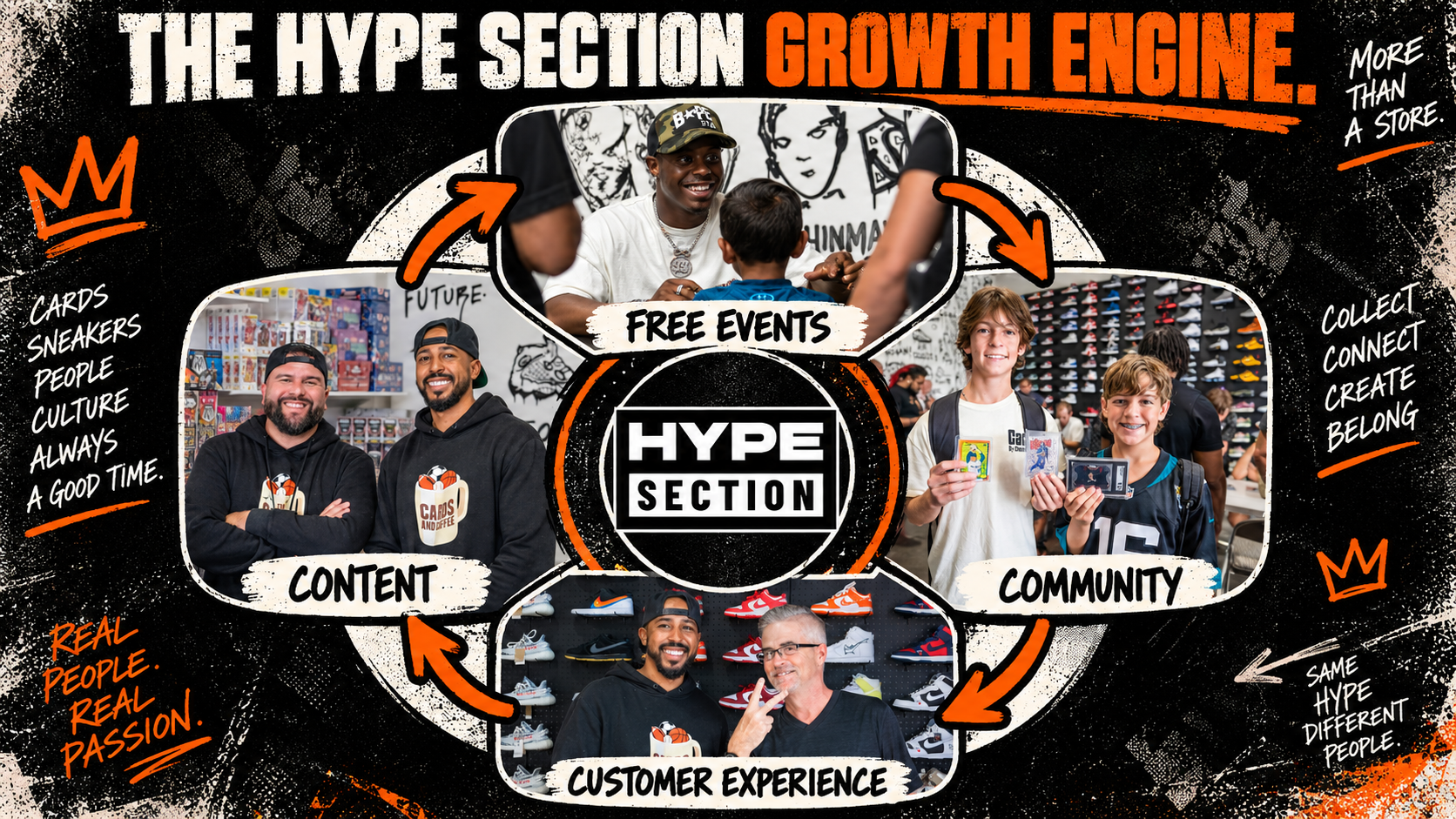
Every month we hosted Trade Nights, with a DJ, pizza and sports-card culture. We also held events with professional athletes, including Travis Etienne, Calvin Ridley and Fred Taylor.
We promoted these events through list broadcasts. By our account, they drew roughly 200–300 people a night and were among the strongest-grossing days each month. Those figures are founder-reported.
Commerce software helped capture the transaction. Community gave people a reason to come back.
Local search
The local SEO and review engine
What we did then: We actively asked customers to leave Google reviews and encouraged specific wording around local search terms, such as sneakers and sports cards in our area. That was part of the store’s 2022 local SEO playbook. Our account is that steady review growth helped the store become highly visible in local search for those categories.
What BestStorefront recommends now: Ask satisfied customers for honest, voluntary reviews, but don’t script the language or steer the rating. The lesson worth carrying forward is consistent review generation — not controlling what customers say.
Lessons
What The Hype Section taught me about ecommerce software
Software should capture value, not just create pages
A commerce platform matters because it supports transactions, customer data, operations and follow-up. A storefront that looks good but cannot help you recognise and reach a customer again is doing only part of the job.
Own the customer relationship
Social platforms generated discovery for us, but we did not control them. Email, SMS and the customer file created an audience the business could reach again on its own schedule.
Online and offline commerce should connect
The Hype Section was a physical store, but the technology layer connected transactions, content, customer data and retention. The in-store sale and the digital follow-up were one system, not two.
A bigger tech stack is not automatically a better one
Each system should have a job. We added tools to capture, organise and reactivate customers, not to collect software for its own sake.
Revenue is not the whole scorecard
$1M in revenue is not $1M in profit. Inventory, rent, payroll, software fees, payment fees, event costs and other operating expenses all belong in the economics of a retail business.
Evidence boundary
What I would test differently today
Running the store shapes the questions I ask about commerce software now. It is not a substitute for current hands-on product testing, and we did not formally test these questions in 2022.
- How easy is it to export the full customer file, including contact details and purchase history?
- How well do Shopify, Square and the customer-data systems sync with each other?
- What is the true combined cost of payment processing and software at our sales mix?
- How easy is it to build segments such as top spenders, lapsed buyers and one-time buyers?
- Which customer data is portable if we move to a different platform?
- How cleanly do the systems integrate without manual exports and imports?
- What happens to data, subscriptions and integrations when you cancel?
- How well does reporting reconcile online and in-store activity?
These are the kinds of checks BestStorefront's methodology is designed to answer, product by product.
Why it matters
Why this story belongs on BestStorefront
BestStorefront evaluates commerce software through the lens of real operations. At The Hype Section, I had to sell inventory, capture customers, drive repeat business, reconcile commerce systems, build retention workflows, generate local demand and keep a physical store running.
This was one store, in one city, at one point in time. It is not a universal blueprint, and it is not evidence that any particular platform is the best choice.
This operator experience informs the questions BestStorefront asks. It does not replace current hands-on software testing.
Disclosure
Sources and scope
Primary source: the founder case study published by Gil Media Group, The Hype Section case study. The three graphics on this page are original founder-provided artifacts from that case study.
- Revenue and operating metrics are founder-reported.
- This case study is an operator account, not a product review.
- BestStorefront has not independently audited the company's financial statements.
- No software product receives a score, ranking or recommendation because of this case study.
- Current BestStorefront reviews, including Shopify and Square, remain subject to the How We Test methodology.
Research